
Interpretive Collapse
Why AI Is Making Smart Companies Make Worse Decisions

AI isn’t failing.
But something inside organisations is.
The data is improving. The models are getting better. Infrastructure is scaling.
And yet decision-making is becoming slower, noisier, and more fragile.
This is the paradox no one is properly naming.
The question nobody is asking
Every serious organisation right now is focused on data quality, model accuracy, hallucinations, and infrastructure risk.
Almost none of them are asking the more dangerous question:
Do we actually agree on what this output means?
Because that’s where things break. Not at the model. Not at the data layer. At the moment a human, or a team, tries to interpret what they’re seeing and act on it.
What Interpretive Collapse is
Interpretive Collapse happens when multiple actors derive different meanings from the same output, and proceed as if they’re aligned.
On the surface, everything looks functional.
Dashboards are populated.
Models are running.
Insights are flowing.
Underneath,Product thinks the output means one thing.
Risk thinks another.
Compliance interprets it differently.
Leadership assumes an alignment that doesn’t exist.
Decisions don’t fail loudly.
They degrade. Quietly.
And by the time the incoherence is visible, it’s already expensive.
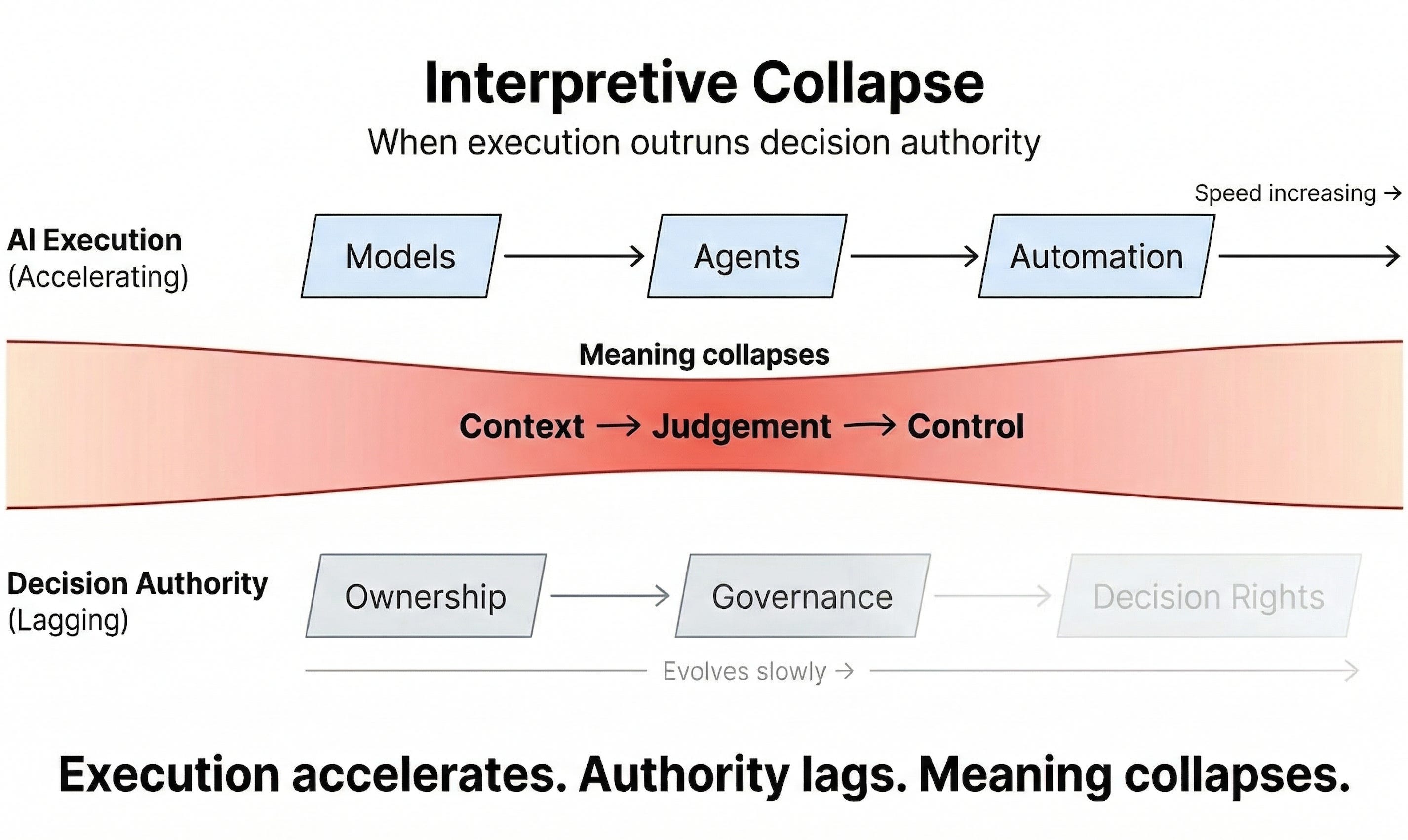
Source: Interpretive Collapse, Predictable Volatiity, Andrew J Turner, March 2026.
Why AI makes this worse
AI doesn’t resolve this problem. It accelerates it.
More outputs. Higher speed.
Less friction to generate “insight.”
Which means more interpretation is happening, by more people, more often, with less shared context than ever before.
You don’t get alignment at scale.
You get interpretive drift at scale.
If you’re interested in how organisations can design decision systems for the age of AI, you can subscribe below to receive future essays in this series.
The shift that makes this unavoidable
As organisations invest in AI literacy, they are training more people to interpret AI outputs.
They are not training them to interpret those outputs the same way.
More capability.
More participation.
More divergence.
What it actually costs
This doesn’t show up in your dashboards.
It shows up as slower decision cycles, circular debates, duplicated work, and meetings that exist only because nobody is quite sure what was decided last time.
And eventually, decisions that look rational.
Confident.
Documented.
Wrong.
The dangerous response
Most organisations respond by investing in better data, better models, and more governance.
All of which are necessary.
None of which solve the problem.
Because you can have perfect data and still make catastrophically bad decisions if the meaning of that data is not shared.
The missing layer
The real gap is a layer almost every organisation is ignoring, the interpretation layer, where meaning is constructed, assumptions are applied, context is injected, and decisions are actually shaped.
Right now that layer is implicit, inconsistent, and ungoverned.
AI is pouring fuel on it.
Where this goes
More AI without addressing this produces a predictable outcome, more outputs, more divergence, weaker decisions.
The appearance of intelligence without coherence.
The organisations that will win aren’t the ones with the best models.
They’re the ones that design how meaning is created, shared, and validated, before decisions are made.
Interpretive Collapse rarely appears suddenly. It is usually the result of something slower, quieter, and far more dangerous, a gradual drift in how meaning is constructed across the organisation.
That’s what comes next.
AI doesn’t break organisations. It exposes the fact that they were never aligned in the first place.
Interpretive Collapse is just the point where that becomes impossible to ignore.
The organisations that master interpretation will outperform those that only invest in models.
But interpretation doesn’t collapse all at once.
It drifts.
Slowly.
Across teams, decisions, and systems, until the gap between what the data says and what the organisation believes becomes impossible to bridge.
Next week, I’ll explore how that drift happens, and why it’s so difficult to see until it’s already done its damage.
Predictable Volatility Series
AI’s Missing Middle
The Interpretation Layer
Interpretive Collapse ← You are here
Interpretive Drift
Decision Architecture
The Override Problem
The Formalisation Trap
The Meaning Audit
If you’re working on AI, data strategy, or organisational decision-making and these questions resonate, I’d be interested to hear how interpretation shows up inside your own organisation.
Predictable Volatility is an ongoing series by Andrew J Turner exploring how organisations convert signals into decisions, and where that process breaks down.
The most interesting reactions so far are not about AI. They’re about decision-making. People aren’t telling me their models are broken. They’re telling me that “We don’t agree on what the outputs mean.” That’s the real problem.
I wondered if you are seeing this too?
What makes this particularly hard to fix is that interpretive drift feels like disagreement about strategy, when it's actually disagreement about meaning, and those require completely different interventions. Most organisations respond by adding more process or clearer governance, but those tools assume people are working from the same semantic foundation, which is precisely what's missing. The interpretation layer isn't just ungoverned; it's often invisible to the people inside it.